

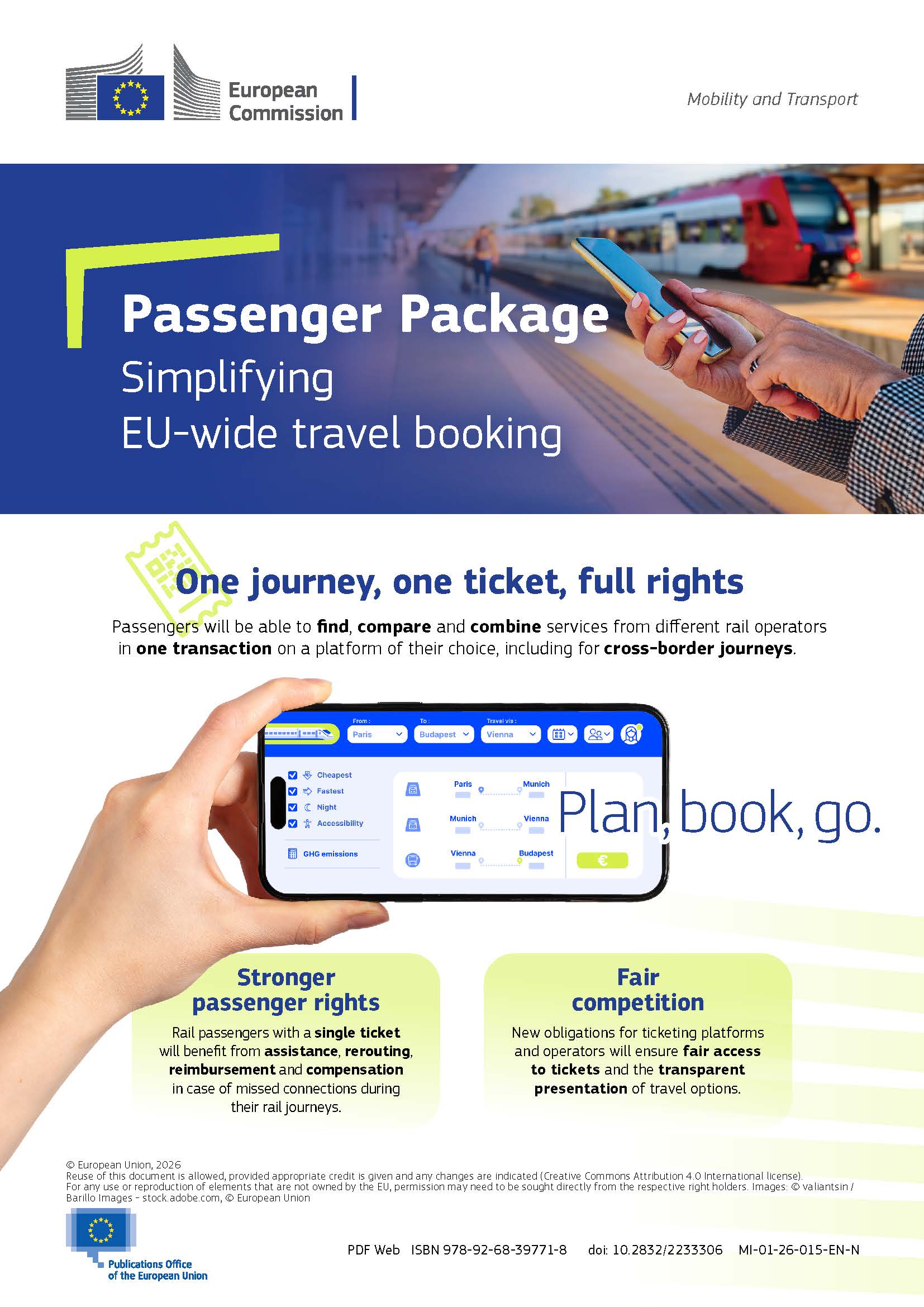
 On 13 May, the European Commission published its long-awaited “Passenger Package”: three legislative proposals aimed at improving rail passenger protection, rail ticketing, and multimodal digital mobility services. Together, these proposals seek to make multimodal and, in particular, multi-operator rail travel, easier to plan and book, while also strengthening rail passenger rights throughout the journey.
Stronger protection for rail passengers travelling across operators
EPF strongly welcomes the proposal to strengthen passenger protection for multi-operator rail journeys. A key improvement is that full passenger rights – reimbursement, re-routing, assistance, and compensation – would apply to all journeys sold as a “single ticket”, provided minimum connection times are respected. EPF’s main concern is that protection against missed connections would remain limited to journeys sold as “single tickets”, meaning that passengers travelling with separate tickets, regional passes, or flexible fares would still not be guaranteed equivalent coverage.
Better ticketing rules are essential
Passenger rights have limited practical value if travellers cannot easily buy integrated rail tickets. EPF strongly supports the objective of enabling passengers to find, compare, combine and purchase rail tickets through the channel of their choice. The proposal pursues this through two complementary approaches: requiring railway operators to provide ticketing content – including discounts –, and real-time data to online ticketing providers; and obliging dominant vertically integrated rail platforms to display and sell competing operators’ tickets within the same geographical area.
The Multimodal Booking proposal falls short of being truly multimodal
Despite some positive measures, e.g. related to transparency and neutral display, the Multimodal Booking proposal falls short of expectations. Unlike the rail ticketing proposal, FRAND (fair, reasonable and non-discriminatory) obligations are not extended consistently across both platforms and operators, despite similar competition concerns, particularly in aviation. As a result, passengers will likely continue to struggle to compare and book seamless door-to-door multimodal journeys, while environmental impact information – mandatory under the proposal – will only be meaningful if available for comparison across multiple modes.
Looking ahead
While the Multimodal Booking proposal is disappointing, the rail proposals are ambitious and, together, the Passenger Package represents an important step towards more accessible, fair, and passenger-friendly mobility in Europe. Key questions remain – on scope, definitions, and implementation – and will need to be addressed during the legislative process. EPF remains open to dialogue with all stakeholders and will continue to contribute constructively in the months ahead. EPF will publish a full analysis in the near future and, in the meantime, invites stakeholders to join us in Maastricht on 5–6 June for further exchanges on passenger rights, ticketing, and multimodal mobility.
 Stay informed!