

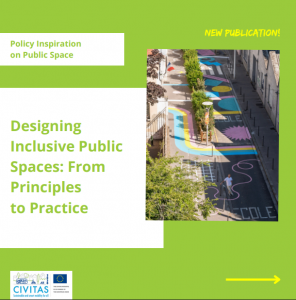
CIVITAS Policy Brief cover page
EPF has contributed to the newly published CIVITAS Inspiration Brief, “Designing Inclusive Public Spaces: From Principles to Practice”, through the expertise of Delphine Grandsart, Senior Researcher at EPF, who is listed among the expert contributors.
The publication explores how cities can move from broad principles of inclusion to practical implementation in the planning and design of public spaces. It reiterates the importance of participation, equity and accessibility in urban environments, recognising that public spaces have often been designed around a narrow set of assumptions that overlook the diversity of users and their needs. In addition, the brief argues that inclusive public spaces are not a specialised add-on, but a fundamental aspect of fair urban design.
EPF’s contribution builds on knowledge and findings generated within the Horizon Europe InclusiveSpaces project, which focuses on improving accessibility and inclusiveness in the built environment. As highlighted in the brief, the project is developing practical planning and design tools to support cities in creating more inclusive public spaces. These include the Comfort-Based Accessibility Tool (CAT) and the Universal Design Manual.
The CAT introduces a broader approach to accessibility by incorporating “discomfort factors” such as slopes, uneven pavements and noise levels, alongside user characteristics. This helps demonstrate how environmental conditions can affect real accessibility and catchment areas for people with diverse needs. Meanwhile, the Universal Design Manual provides comprehensive recommendations for the built environment, covering public transport stations, stops, first and last-mile connections, and mobility hubs.
The CIVITAS brief also emphasises three key enablers for inclusive public space design:
- Co-creation and meaningful participation, ensuring that diverse lived experiences inform planning and design;
- Training and capacity building, equipping planners and decision-makers with the skills to identify and address exclusion;
- Digital and decision-support tools, helping cities analyse accessibility barriers and prioritise interventions.
For EPF, this contribution reinforces the importance of ensuring that transport users, especially groups vulnerable to exclusion and underrepresented groups, are placed at the centre of urban mobility planning. Through InclusiveSpaces and broader policy engagement, EPF continues to advocate for accessible, inclusive and passenger-centred mobility systems across Europe.
The CIVITAS Inspiration Brief offers valuable insights for cities, mobility planners and policymakers working to translate inclusive mobility principles into everyday urban practice.
You can access the full brief here.
 Stay informed!