

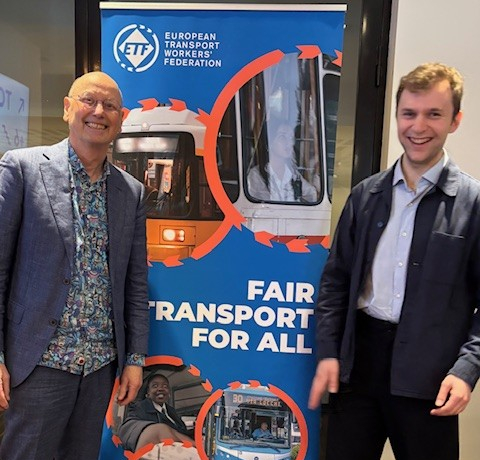
EPF was represented by Management Board member Walter Etty at the European Transport Workers’ Federation (ETF) conference “Building Coalitions for Better Public Transport” on 9-10. December 2025 in Brussels. EPF was invited by the Urban Public Transport Committee of ETF, reflecting the shared understanding that high-quality public transport services and high-quality jobs go hand in hand.
The conference brought together representatives from public transport unions, green campaigners, passenger groups, disability rights activists, employers, and policymakers, including MEP Lena Schilling, coming from all over Europe, to explore how broader coalitions can help deliver better public transport in Europe. A strong emphasis was placed on sustainable public transport in livable cities, with discussions framed within the context of the European Green Deal and a just transition for workers and passengers alike.
Walter Etty spoke on behalf of EPF in a panel titled “Where do we agree, where do we disagree? – Mapping converging and diverging priorities for the sector”, alongside representatives from the European Cyclists’ Federation, the European Network for Independent Living, the European Transport Safety Council, Transport & Environment and SYPROLUX. The discussion focused on identifying common ground between passengers, workers and other stakeholders, while openly addressing areas of tension.
In his intervention, Walter underlined EPF’s core position: public transport exists to serve passengers, and passengers must have a place in decision-making processes. EPF and its member organisations across Europe work daily to organise, inform and support passengers, while listening to their complaints and suggestions. At European level, EPF advocates for sustainable mobility and higher standards in public transport by conducting research, publishing reports, organising conferences and engaging constructively with operators, policymakers and industry stakeholders.
From an urban mobility perspective, EPF emphasised that passengers want door-to-door journeys that are seamless, affordable, reliable and accessible. Public transport should contribute to high-quality public space and be fully integrated with walking and cycling, while offering an attractive alternative to private cars through better connectivity and higher service frequency. EPF also stressed the importance of integrating urban public transport into regional, national and international networks, including harmonised passenger rights, booking systems and through-ticketing.
The panel discussion openly addressed areas where interests may diverge, including the impact of strikes on passengers and differing views on competition in public transport service delivery. At the same time, EPF highlighted strong shared priorities with workers and other stakeholders, particularly the need for safe, accessible, well-funded public transport operated by well-trained and fairly paid professionals.
Looking ahead, EPF welcomed the conference’s focus on coalition-building and reiterated the need for stronger, more coordinated advocacy at both EU and national levels. Increased and structural funding for urban, regional and cross-border public transport remains essential if public transport is to play its full role in delivering livable cities and sustainable mobility for passengers across Europe.
 Stay informed!