


Shaping user acceptance through inclusive AV experiences
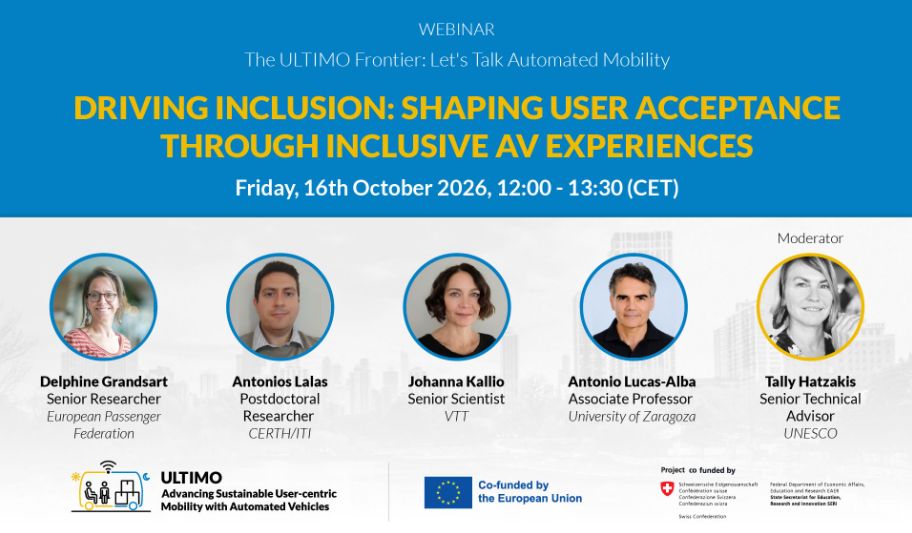
How can we ensure that automated mobility meets passengers’ needs and gains public acceptance? This was one of the key questions addressed during the ULTIMO webinar, “Driving Inclusion: Shaping User Acceptance Through Inclusive AV Experiences”.
Drawing on lessons learned from European Connected, Cooperative and Automated Mobility (CCAM) projects, including SHOW and Ride2Autonomy, EPF highlighted the importance of putting passengers at the centre of innovation and ensuring that new mobility services respond to their needs and expectations. The key message: before developing a new mobility service, we must always ask, “Is this what we want and need?” Rather than taking a technology-push approach, innovation should start with passengers and the challenges they face in their everyday journeys.
Three principles for building trust in automated mobility
For automated mobility to gain public trust and acceptance, EPF emphasised three essential principles:
- Seamless: Automated mobility should be usefully integrated into the wider transport system, offering passengers a comfortable, connected journey.
- Inclusive: Services should ensure fair access and deliver value for diverse passengers, taking into account their different needs and expectations.
- Trustworthy: Automated mobility services must be safe, reliable, transparent and accountable.
Lessons learned from the SHOW project: engaging users and stakeholders
EPF shared its experience from the European SHOW project, in which it was responsible for coordinating end-user and stakeholder engagement activities. As part of this work, EPF developed a framework and guidelines to help SHOW pilot sites design and implement engagement strategies tailored to their local contexts.
A wide variety of activities were carried out to involve citizens, potential users and other stakeholders in exploring and experiencing automated mobility. These activities ranged from surveys and demonstration days to engaging “Supertesters”, drawing contests, conferences, ideathons and hackathons. More creative initiatives also helped bring automated mobility closer to the public, including letters delivered to Santa by an automated robot.
Building on these experiences, EPF shared lessons learned about user and stakeholder engagement, including what works well and what barriers can hinder meaningful participation. The experience reinforces the importance of adapting engagement strategies to different audiences and contexts, and of involving people throughout the innovation process rather than only once solutions have already been developed.
CCAMbassador: understanding acceptance and building capacity
EPF also presented its work in the CCAMbassador project, which addresses another important dimension of automated mobility: understanding how it is perceived by the wider public and those who may be affected by its introduction. As part of this work, EPF will engage with the general public, including users, citizens and the mobility workforce, to assess their acceptance of automated mobility. The project will also include awareness and capacity-building assessments and campaigns. This work aims to contribute to a better understanding of public perceptions and to support the knowledge and awareness needed for the responsible introduction of automated mobility.
EPF’s position on automated mobility: citizens first
Finally, EPF referred to its recently adopted position paper on automated mobility, which sets out the principles that should guide the development and deployment of automated mobility in Europe. The position paper highlights several key messages:
- Put citizens at the centre: Mobility solutions should respond to people’s needs and expectations.
- Automation is a means, not an end: Technology should serve clearly defined mobility objectives, rather than being pursued for its own sake.
- Advance inclusive and sustainable mobility: Automated mobility should contribute to a transport system that works for everyone and supports sustainability.
- Strengthen public transport and fill genuine gaps: Automation should complement and reinforce public transport, addressing real unmet mobility needs.
- Prioritise shared and integrated mobility: Automated services should be part of a connected transport system, rather than isolated solutions.
- Evidence before scale: Wider deployment should be guided by evidence of benefits, effectiveness and suitability for passengers and society.
More information
👉 EPF’s presentation
👉 EPF’s position paper on Automated mobility
