

Europe has experienced a boom in mobility over the last decades. To protect citizens and to ensure they are not lost in national rules, the EU has adopted community legislation covering passenger rights – across all transport modes.
Did something go wrong with your trip? Have you experienced delays and cancellations? Do you have special mobility needs? As an air, rail, ship or bus passenger, you have rights when travelling in the European Union.
EU passenger rights are adapted to each means of transport, but in essence, the rights that apply to all types of transport are comparable. They are based on three key principles: non-discrimination; accurate, timely and accessible information; immediate and proportionate assistance. These principles are the foundation for ten basic rights that form the core of EU passenger rights policy.
A very useful Passenger Rights smart phone application available in 22 languages, helps travellers easily access their rights while on the move – the best way to have Your Passenger Rights at Hand!
A Eurobarometer survey (2024) found that 73% of EU citizens used at least one mode of transport over the past 12 months, most often local urban transport (52%), followed by rail (33%), air (23%), coach (14%), and ship or ferry services (8%). Awareness of passenger rights remains limited: 33% of respondents are aware of their rights when travelling by rail, 30% by air, 27% by coach, and 16% by ship or ferry. Nearly half of rail passengers (47%) and three in ten air passengers (30%) experienced at least one disruption to their journey during the past year, most commonly departure delays.
Apostolos Tzitzikostas, European Commissioner for Sustainable Transport and Tourism, oversees the portfolio that includes EU transport and tourism policy.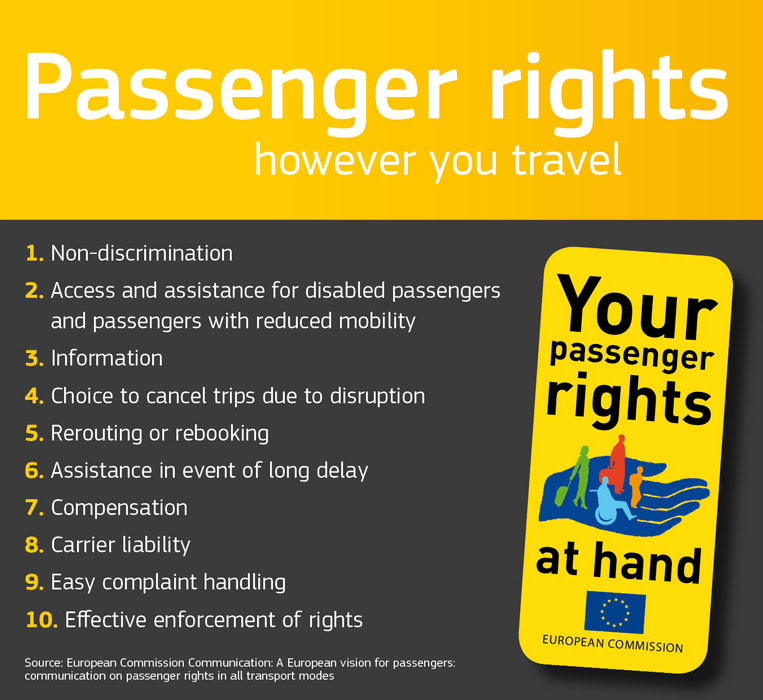
EU rail passenger rights generally apply to all international rail journeys within the EU. National governments can decide for themselves whether or not these rights also apply to domestic rail services (regional, urban, suburban transport) and international services that start or finish their journey outside the EU.
Pricing
When buying a train ticket, you may not be charged a higher price because of your nationality or where you are buying the ticket from.
Delay or cancellation
If your train is delayed or cancelled, you have the right to adequate and timely information. In case of a cancellation or a delay of more than 1 hour, you have a choice between re-routing or a refund. A refund, where relevant, includes a free journey back to the initial departure point. Re-routing should be offered under comparable travel conditions at the earliest opportunity, or rebooking at a later date of your convenience. You will also be offered additional assistance such as meals and refreshments and, if necessary, accommodation.
Compensation
Liability towards passenger and luggage
Rail undertakings can, under certain circumstances, be held liable for injury or death resulting from an accident. In case of lost or damaged (registered) luggage, passengers may also be entitled to compensation.
Complaints
If you are not satisfied with how your rights have been applied, you should first contact the rail undertaking. If you are not satisfied with their response, you can lodge a complaint with the National Enforcement Body in your country of residence.
For more information and advice on your rights and how you can get a refund or compensation, visit the ‘Your Europe’ passenger rights website. Rail passenger rights legislation, policy documents and studies can be found here.
LATEST DEVELOPMENTS
The European Commission has revised the rights of passengers in railway transport (Regulation 1371/2007). To this end, it published several documents together with proposed amendments and possible implications. EPF monitored closely the developments on this legal text since the beginning of the negotiations.
EPF has issued a statement (download here) as a reaction to the proposed Recast of Regulation (EC) 1371/2007 on rail passengers’ rights and obligations. The Regulation proposal 2017/0237 can be summarized as follows:
- Member States can still derogate from the Regulation for regional and suburban rail services and urban transport. But mainline and national services are no more exempted.
- Compensation principle in case of delays for connecting trains – but railway undertakings can escape it if they inform customers that they don’t accept this principle.
- More obligations for ticket vendors (different from rail undertakings), infrastructure managers and station managers.
- Exemption of compensation obligation for delays caused by strong meteorological or major natural circumstances.
We then welcomed the position taken by the Parliaments in its plenary vote of 15th November 2018; this vote reflected the need for passengers’ rights to be properly protected in the event of disruptions to rail services.
During the trilogue agreement of 1st October 2020, we understood that many of the Parliament’s laudable objectives fell through in the negotiations. EPF issued a statement reporting our concerns regarding the new text (that can be found here). We continued working with the involved parties, through several meetings where we expressed our concerns.
On 17 May 2021, the regulation was published in the Official Journal of the EU, with the transition period lasting until 7 June 2023. However, member states have until 7 June 2025 for applying Article 6(4), regarding procurement and upgrade procedures for rolling stock.
The full regulation (EU) 2021/782 can be found here.
EU ship passenger rights generally apply if you are travelling within the EU on large ferries and cruise ships on sea, rivers, lakes or canals. They do not apply to small ships (not more than 13 passengers and/or 3 crew members), most historical ships, excursion and sightseeing ships.
Pricing
When buying a ship ticket, you may not be charged a higher price because of your nationality or where you are buying the ticket from.
Delay or cancellation
If your ship is delayed or cancelled, you have the right to adequate and timely information. In case of a cancellation or a delay of more than 90 minutes, you have a choice between re-routing or a refund. A refund, where relevant, includes a free journey back to the initial departure point. You will be also be offered additional assistance such as meals and refreshments and, if necessary, accommodation.
Compensation
In case of a delay of at least 1 hour, you may be entitled to a financial compensation of 25% to 50% of the ticket price. If the delay is caused by severe weather conditions or natural disasters, or if you were informed of the delay before you bought the ticket, you will not receive any compensation.
Liability towards passenger and luggage
In the case of injury or death resulting from an accident at sea, passengers (or their successors) have a right to compensation from the carrier. In case of lost or damaged luggage resulting from accidents, passengers are also entitled to compensation.
Complaints
If you are not satisfied with how your rights have been applied, you should first contact the shipping company. If you are not satisfied with their response, you can lodge a complaint with the National Enforcement Body in your country of residence.
For more information and advice on your rights and how you can get a refund or compensation, visit the ‘Your Europe’ passenger rights website. Maritime passenger rights legislation, policy documents and studies can be found here.
If you have reduced mobility, you should still be able to travel like anyone else, at no extra cost.
You can’t be stopped from buying a ticket, making a reservation or getting on board of an airplane, train, bus, coach or ship because of your reduced mobility – unless it is physically impossible or there are security concerns.
Disabled travellers or travellers with reduced mobility are entitled to assistance, free of charge:
- getting on and off the train / bus / coach / airplane / ship
- on board during the journey
- at the airport, bus terminal, port or station before and after the journey.
- at least 48 hours before the journey if you travel by plane, train or ship
- at least 36 hours before the journey if you travel by bus or coach.
Transport companies are not obliged to provide help with eating, taking medication etc. If you need this type of help, they might require that you be accompanied by another person. In some cases, this companion may travel for free or at a reduced price.
For more information and advice on the rights of passengers with reduced mobility, visit the ‘Your Europe’ passenger rights website.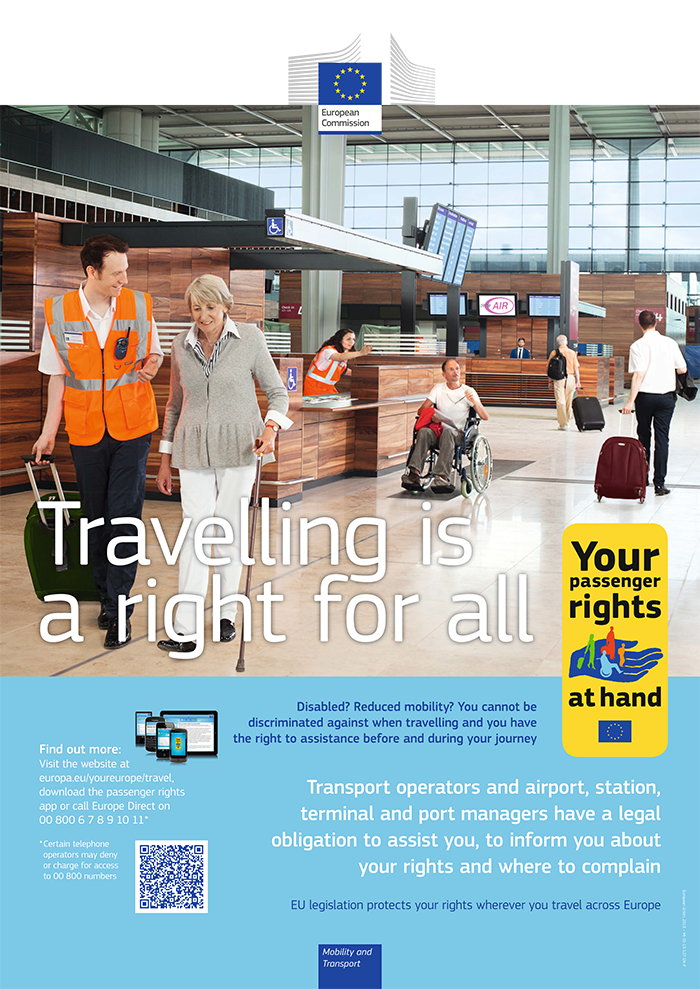
On December 22nd 2016, the European Commission published a first political analysis of activities which might be needed to implement ‘multimodal passenger rights’. The document can be found here.
EPF welcomes the initiative of the European Commission to address the improvement of multimodal passenger rights. Extending the legislation on passenger rights to multimodal journeys is of key relevance to passengers as most journeys are effectively multi-modal. From a user’s point of view there is a need to understand journeys as a door to door trip. This means any action has to cover full travel-information, through ticket and options for through booking over the whole journey. Any operators need to collaborate in case of problems and take responsibility to the passengers.
EPF’s contribution to the survey ‘Public Consultation on a possible initiative at EU level in the field of passengers rights in multimodal transport’ can be consulted here.
The draft executive summary of the study conducted on multimodal passenger rights is available (March 2019) and can be downloaded here.

 Download the particular paper by the icon.
December 2025
Review of the Air Services Regulation – EPF position
Review of the Air Services Regulation – EPF response to the public consultation
October 2025
VAT Package on Travel and Tourism – EPF response to the Call for evidence
VAT Package on Travel and Tourism – EPF response to the public consultation
September 2025
EU Sustainable Tourism Strategy – EPF response
Targeted revision of the Rail Passengers’ Rights Regulation – EPF response to the Call for evidence
August 2025
EU Civil Society Strategy – EPF response
June 2025
EU air services rules (revision) – EPF response to the Call for Evidence
May 2025
Connecting Europe through high-speed rail – EPF response to the Call for Evidence
EPF’s Complementary Contribution to the Public Consultations on the Next Multiannual Financial Framework (MFF) post-2027
December 2023
Review of the Package Travel Directive
October 2023
Multimodal Digital Mobility Services – EPF position
August 2023
Bus and Coach Passenger Rights – EPF recommendations
June 2023
EU-wide multimodal travel – new specifications for information services – EPF feedback
Open letter to EVP Timmermans on Multimodal Digital Mobility Services
April 2023
Better protection for passengers and their rights – EPF position paper
November 2022
Response to the public consultation on Better protection for passengers and their rights
October 2022
Response to the public consultation on CountEmissions EU
June 2022
Response to the public consultation on Increasing the share of rail traffic
May 2022
Response to the public consultation on Increasing the share of rail traffic
Response to the public consultation on Increasing the share of rail traffic
March 2022
Response to the public consultation on Multimodal Digital Mobility Services
November 2021
Response to the EU public consultation on A Drone Strategy 2.0
Open letter on the EU’s Urban Mobility Framework
October 2021
EPF position paper: State aid as a means to support a sustainable recovery of the transport sector
March 2021
Sustainable and smart mobility strategy – EPF contribution COTER consultation
EPF position paper: Towards a performance regime between infrastructure managers and railway undertakings
February 2021
Revision of the ITS Directive – EPF contribution public consultation
October 2020
EPF response to the New Consumer Agenda consultation
September 2020
EPF response to the 2011 White Paper evaluation consultation
August 2020
EPF response to the evaluation of Bus and Coach Passenger Rights
EPF response to the evaluation of Passenger Rights by Sea and Inland Waterways
March 2020
Older versions
December 2019
EPF response to the Urban mobility consultation
November 2019
Position paper on Rail safety data
September 2019
Review of the Air Services Regulation – Provisions on price transparency
August 2019
EPF priorities for future EU action
June 2019
The potential of the rail sector in delivering EU policy priorities
January 2019
Opening national and international markets for coach services
Review of EU Code of Conduct for Computerised Reservation Systems
November 2017
Recast of Regulation (EC) 1371/2007 on rail passenger rights: EPF statement
July 2017
February 2017
4th Railway Package: A missed opportunity
November 2016
The European Commission’s proposed European Accessibility Act
October 2016
September 2016
Security in public passenger transport – EPF asking for appropriate and scalable solutions
June 2015
EPF submission to the consultation on the mid-term review of the 2011 White Paper on transport
March 2015
EPF submission to the Committee of the Regions on the White Paper on Transport
POSSIBLE EUROPEAN INTERNATIONAL EURO-CITY TRAINS NETWORK
February 2015
Letter EPF concerning Revision Package Travel Directive
EPF submission to the European Economic and Social Committee on the White Paper on Transport
December 2009
EPF Response to questions on regulatory options for further market opening
August 2009
EPF response to the EC consultation on A Sustainable Future for Transport
June 2009
EPF response to the EC consultation on A Sustainable Future for Transport
April 2009
EPF response to a letter from the EC about information on incidents regarding baggage
September 2003
Position paper on the Green Paper on Services of General Interest